
Orthoptics
About this course
- Starts
- September 2025
- UCAS Code
- B520
- Duration
- 3 years
- Entry Requirements
- Standard: BBBAccess: BBC
Course description
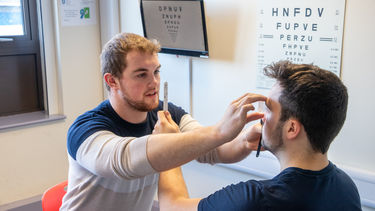
Become a specialist at diagnosing, managing and treating eye movement disorders and visual impairments.
A degree in orthoptics from the University of Sheffield can take you in so many directions in healthcare – from an NHS hospital or community eye clinic to a rehabilitation centre for patients with neurological conditions.
This orthoptics programme is designed to give you a deep understanding of the human eye and different eye conditions.
We’ll lay the groundwork, introducing you to the basic anatomy and physiology of the human eye, before going on to explore topics such as ocular misalignment (strabismus), eye movement disorders, ocular diseases and medical microbiology. You’ll also learn how the NHS works, and explore topics such as medical ethics and law.
You’ll go on to work with patients and clinicians in specialist departments throughout the UK, developing the skills you need to flourish in a multidisciplinary eye care team.
Why study this course?
- Hands-on clinical experience - placements in orthoptic departments across the UK and Ireland give you valuable personal and professional experience. Over the three-year course you’ll spend 32 weeks on placement, learning from the experts and spending vital time with patients with a range of eye disorders.
- Delve into research - in your final year, you’ll put everything you’ve learned into practice with a research project or literature review on a topic that interests you. You might have the opportunity to present your findings at a conference or have your work published in a medical journal.
- £6,000+ annual NHS training grant - annual NHS grants are available for all eligible UK home students to help you with your studies, as well as funding to cover the cost of placements.
Foundation courses
Mature students without standard entry qualifications can also study this course with a foundation year, which prepares them for degree-level study. For more information and entry requirements, visit the Department for Lifelong Learning.
This course is approved and accredited by the Health and Care Professions Council (HCPC).
Careers
Orthoptics is a fantastic field for graduates, with plenty of opportunities to specialise or progress.
Most of our graduates have gone on to work in eye departments in the NHS. Alternatively, you might choose to work in an orthoptic clinic in a private hospital, health centre or school for children with special needs. The course also provides an excellent foundation for future postgraduate research in orthoptics and related fields.
The Sheffield BMedSci in Orthoptics is recognised worldwide. Graduates have worked in New Zealand, Australia, the USA, the United Arab Emirates, Hong Kong, Malta, Cypress, Denmark and Gibraltar.
Orthoptists can progress into more senior positions and clinical management as their clinical experience develops. You might end up taking on a specialist role involving ocular assessment, diagnosis and treatment in fields such as low vision, stroke and neuro-rehabilitation, vision screening, and ocular diseases such as glaucoma, age-related macular degeneration, diabetic retinopathy and cataracts.
School of Allied Health Professions, Nursing and Midwifery
Our graduates work in orthoptic clinics in hospitals, health centres and schools for children with special needs. Others go on to postgraduate research in orthoptics and related fields. We offer a distance learning Masters in Vision and Strabismus specifically aimed at orthoptists and offer excellent PhD opportunities.
This orthoptics degree is recognised worldwide. Graduates have worked in New Zealand, Australia, USA, United Arab Emirates, Hong Kong, Malta, Cypress, Denmark and Gibraltar.
Orthoptists can progress into more senior positions and clinical management as their clinical experience develops. Many orthoptists also take on one or more specialist role which may involve ocular assessment, diagnosis and treatment in example Low Vision, Stroke and neuro-rehabilitation, Vision Screening, and ocular diseases such as Glaucoma, Age Related Macular Degeneration, Diabetic Retinopathy and Cataract.
Entry Requirements
The A-Level entry requirements for this course are:
- A Levels + a fourth Level 3 qualification
- BBC including B in a science subject + B in a relevant EPQ; BBC including B in a science subject + B in Core Maths (not applicable if Maths is taken at A Level)
- International Baccalaureate
- 32 with 5 in a Higher Level science subject
- BTEC Extended Diploma
- DDD in Applied Science
- BTEC Diploma
- DD in Applied Science + B in an A Level science subject
- T Level
- Distinction in the Health, Healthcare Science or Science T Level, including grade B in the core component
- Scottish Highers + 1 Advanced Higher
- ABBBB + B in a science subject
- Welsh Baccalaureate + 2 A Levels
- B + BB including a science subject
- Access to HE Diploma
- Award of Access to HE Diploma in a relevant subject, with 45 credits at Level 3, including 24 at Distinction and 21 at Merit
-
Science subjects include Biology/Human Biology, Chemistry, Maths, Physics or Psychology
-
GCSE Maths, English and Science grade 4/C